
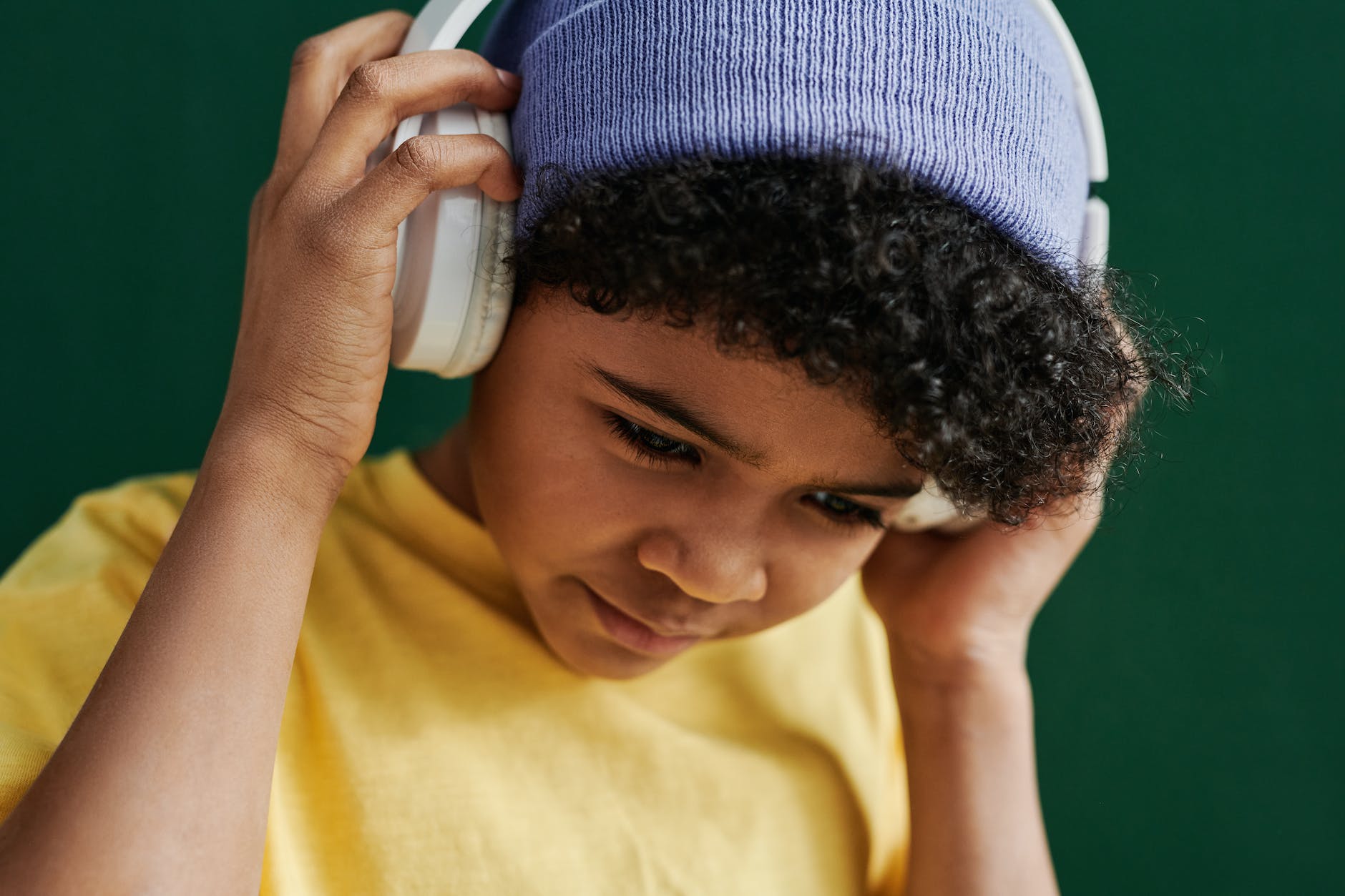
There are many causes of early childhood or teen onset hearing loss, tinnitus, and/or hyperacusis (decreased sound tolerance). Unlike other causes, early noise damage to hearing health is entirely preventable. Personal audio system manufacturers aren’t making them much safer, despite the urgent need. It’s up to parents, caregivers, and responsible adults like educators to teach children and adolescents about safer personal listening habits, and the danger of listening at loud volumes through headphones/earbuds.
Children and teens often use headphones/earbuds for fun, e.g. audio books, music, gaming. Personal listening is common while studying at home or at school. Schools increasingly require headphones/earbuds for learning activities with audio or audiovisual content. This widespread early personal listening is linked to the rising epidemic of noise-induced hearing health damage in children as young as 6 years old. Preventable noise-induced hearing loss is now a young person’s disease, starting in childhood.
| Age | Prevalence of Personal Audio System Users |
|---|---|
| 6 | 29% |
| 9 | 59% |
| 12 | 80% |
| 12-19 | 85-95% |
Millions of children and teens worldwide are at risk from using unsafe personal audio systems at loud mid to high volume settings. Parents should delay personal listening as long as possible. It’s a privilege children can earn when they’re old enough to understand the safety risks and take responsibility for their own hearing health.
How do you know if they’re ready? Are they responsible for their health in general? Do they wear protective gear and follow safety rules as needed for risky activities, e.g. around your home, biking, swimming, skateboarding, gym class. Are they ready to accept the risks of using headphones?
I developed a child-teen personal listening agreement to help with this discussion.
Contents
- Hearing Health Hazard Info
- Talking About Personal Listening Risks
- Choosing Safer Personal Listening Systems
- Personal Listening Volume Safety Chart
- Teaching Safer Habits for First and Early Personal Listening
- Supervising Safer Listening Habits for Children and Teens
- References
Hearing Health Hazard Info
Part of being old enough to accept responsibility for personal listening is accepting the risk of permanent hearing health damage. For example, there is a 4x higher risk of hearing loss in personal audio system users, and 28% risk of tinnitus compared to 8% in non-users.
Before my kids started personal listening, they had to explain the hearing health hazards in their own words. First, I taught them about the info here, which is based on current noise science. Talking about personal listening risks is not a one time conversation.
Teach your child or teen what they need to know about noise-induced hearing health damage long before they’re exposed to amplified audio through headphones/earbuds. What hearing health hazards are most important to you? What’s most important for your child or teen? Use your own words and personal examples.
Noise includes wanted sound or music if it’s harmfully loud. Just because you like it, doesn’t make it safe.
The highest risk or loudest personal listening is linked to:
- children and teens aged 12-19.
- music.
- gaming.
- cell phones.
- poorly fitting headphones or earbuds without sound isolating or noise cancelling features.
- 1-3+ hours of daily personal listening.
- 50%+ volume setting, including 11 year olds with higher rates of tinnitus than non-users, listening about 1 hour daily at about 50% volume.
Scientists used to think that noise mainly caused hearing loss after damaging the inner ears or cochleas (sensory damage). Based on that, public health authorities identified that amplified sound exposures <70 dB daily average (Lex,24-hour) should protect adults from noise-induced hearing loss over the course of their lifetime (EPA, 1974, WHO, 1998, 2018). The auditory injury threshold is 75-78 dB+ no matter how short the listening time.
With noise damage, it’s not just that people can’t hear important sounds. What they can hear is distorted and unclear. Science shows noise injuries begin with neural damage by triggering hearing nerve degeneration and impaired sound processing in the brain’s central auditory system. This is linked to hidden hearing loss or impairments not measured on a standard hearing test or audiogram, e.g. tinnitus, hyperacusis or decreased sound tolerance, impaired speech understanding, and/or pitch distortion or diplacusis, that can develop while hearing still tests within the “normal” range.
| Noise Risks Include: | Examples of Hearing Health Impact: |
| Pitch Distortion (Diplacusis) | Music blurred or out of tune. |
| Tinnitus | Hearing extra sounds or static. |
| Hyperacusis | Everyday sounds hurt ears, e.g. broken volume control, stuck on loud. |
| Hearing Loss | Muffled or unclear hearing for sounds and voices. Can’t hear high pitched sounds, e.g. nature, birdsong. |
Hidden hearing loss can develop in <5 years of unsafe personal listening, and hearing loss in 5+ years. Both usually start with invisible, painless damage. There are rarely warning signs. Sometimes after loud listening or sound exposures, people notice “temporary” hearing changes that usually go away within seconds to 24-hours later, e.g. muffled hearing, tinnitus, hyperacusis, and/or pitch distortion.
“Temporary” changes are a sign of underlying hearing nerve damage. If they don’t turn down the volume, every time it happens, people are higher risk that next time the problem could turn permanent, e.g. tinnitus forever.
Average sound exposures <70 dB (Leq,24-hour) may be low enough to prevent hearing loss, at least in exposed adults. But when brain health or neural processing is considered, renowned noise scientist Jos. J. Eggermont identified amplified exposures <65 dB to protect children and teens, although noise exposures <50 dB may be needed to protect developing brain health from noise pollution sources, e.g. construction, traffic, public transit.
Children and teens are considered noise-sensitive or higher risk at and below exposures considered safe for adults, especially if they have pre-existing sensorineural hearing loss, tinnitus, and/or hyperacusis. Increased risk factors include:
- Noise damage happens fastest in the early years of exposure.
- Negative impact of preventable noise damage during auditory development. Human hearing systems from the ears to the brain continue developing into the late teens to early 20s.
- Lifelong negative impacts of early-onset hearing loss and hidden hearing loss. Impaired quality of life at home, school, and play extends to:
- speech and language development.
- cognition.
- speech communication.
- social and interpersonal relationships.
- self-esteem and mental health, e.g. anxiety, depression.
- education and academic success.
Talking About Personal Listening Risks
When talking about personal listening risks, children and teens typically respond best to messages about the personal impact of noise-induced hearing health damage. A major selling point is that their music will sound bad.
Consider listening to audio examples of Noise & Hearing Damage Simulations at my blog or at my SoundCloud. (Use a low comfortable volume!)
Musicians protect their hearing from loud music for a reason. Talk about the negative impact of hearing health damage on themself, their family, social life, school, hobbies, music enjoyment, dream jobs, and mental health.
For example:
- Can they explain the hearing health hazards of loud personal listening? Do they know that only some people get early warning signs? (e.g. “temporary” hearing problems after loud listening.)
- What are their favourite sounds, music, and voices?
- If they lost their hearing health, what would they miss?
- What would it be like if they couldn’t understand what people say?
- What impact would permanent hearing health damage have on their life, e.g. at home, school, play, and later work?
- What would it be like if they had forever tinnitus or hyperacusis?
- How would they feel if they couldn’t enjoy music anymore?

Choosing Safer Personal Listening Systems
There is no such thing as a “safe” personal audio system. Using headphones/earbuds exposes users to highly amplified sound output that defaults to the highest volume. There are safety issues with stock/default headphones and earbuds. Talk to kids and teens about these risks, and choose safer personal listening systems together.
- Avoid use of cell phones or mobile phones for personal listening until late childhood or teen years, if possible. Output is high even at lower volume settings, compared to other devices.
- Choose well-fitting headphones with noise canceling or sound isolating features. These allow safer lower user volume settings even in busy or crowded spaces.
- Earbud styles are generally ok to use starting around age 13+ if they fit snugly, if no recent history of ear infections, or other individual reasons not to use this style. Reasons for waiting until older to use earplugs include: sizing is generally for mature or adult ears, higher risk of ear infections, and general advice for kids not to put anything smaller than their elbows in their ears.
- Beware headphones falsely marketed as “safe” for children, e.g. 85 dB noise limit that may or may not work as advertised. The wirecutter.com regularly shares options for headphones and earbuds recommended for different ages and activities.
- Together, let the child/teen turn on and turn down any built-in output limits and safer listening features or settings to the lowest decibels possible, e.g. audio, headphones. Consider locking the max volume under parental controls after your child has found their lowest functional volume setting and safer volume range.
Warning: Even at the lowest settings, children and teens can be exposed to harmfully loud sound energy without getting any unsafe listening alerts.
Personal Listening Volume Safety Chart
Devices have visual displays with volume setting indicators, e.g. number of bars. There are no manufacturing standards, so sound output can vary a lot depending on the device and headphone/earbud combination.
| User Volume Setting | Estimated Loudness (Average Intensity dB=decibels) | Personal Listening Hearing Health Risk |
| 80%- Full On | Extremely Loud (>100 dB) | Extremely unsafe |
| > 60% | Very Loud (> 80 dB) | Very unsafe |
| 60% | Loud (~80 dB) | Unsafe |
| 75-78 dB Noise Auditory Injury Threshold No Matter How Short the Listening Time | ||
| 50% | Loud (~70 dB) | Unsafe |
| < 50% | Quiet to Moderately-Loud (<70 dB) | Safer for adults |
| Margin of Safety Below 70 dB (Leq,24-hour) | ||
| <40-45% | Quiet to Moderately Loud (<65 dB) | Safer for children, teens and anyone with pre-existing sensorineural hearing loss, tinnitus, and/or hyperacusis |
Teaching Safer Habits for First and Early Personal Listening
Don’t ignore the danger in headphones. The battery charger for my child’s new electric bike has a better safety warning than any personal audio system sold today.
It includes: “This appliance can be used by children aged from 8 years and above…if they have been given supervision or instruction concerning use of this appliance in a safe way and understand the hazards involved.”

Supervising a child’s first and early use of personal listening systems includes talking about hearing health hazards, practicing safer use of personal listening systems together, and check-ins over time.
When picking the lowest functional volume setting, a child with typical or normal hearing will choose around 20% to 25% as a comfortable volume setting for personal listening. This gives a margin of safety where occasional louder listening is okay as long as the volume setting stays well below 50%.
If a child or teen has hearing loss or atypical hearing health, their lowest functional volume setting will depend on how severe. They should still be able to find a personal listening range loud enough to hear, understand, and enjoy audio while avoiding unsafe loud sounding volumes. If a child/teen gets ear infections, changes in functional volume settings can help guide when their hearing is affected and when to seek healthcare.
- Do they know the less time spent personal listening and the lower the volume, the lower the risk of hearing health damage?
- Can they turn on and/or turn down built-in output limits or safer listening features to the lowest dB possible?
- Do they know what to do if they notice early warning signs of hearing health damage from noise? E.g. muffled hearing, talking loud, ringing in the ears (tinnitus), or sound sensitivity after loud personal listening even if symptoms only last a few seconds or minutes.
- Can they put on their headphones so they fit properly around their ears? Or if old enough to use well-fitting earbud styles, do their earbuds fit snugly?
- Do they know how to check the volume control setting? Will they use the lowest functional volume needed while personal listening?
- For first and early use of headphones, have the child practice finding their lowest functional volume for various audio content or sources, depending on what they’re interested in:
- The lowest volume setting needed is likely different for audio books, music, gaming, soundtracks, or other audio/audiovisual sources.
- They should start at zero and slowly turn the volume up. What volume can they first hear at? When does it sound comfortable? When can they hear and understand? When does music sound nice but not loud?
- If they were singing along or dancing, would their functional volume go up? Is it still within a safer volume range?
- As children/teens get used to using headphones/earbuds, they tend to turn up the volume. Keep reminding them about noise risk to hearing health. There’s a limited safe volume range, and loud volume settings are unsafe even if they like the music or audio playing.
- For noisy hobbies or activities where kids/teens still want personal audio, it’s better to use hearing protection like earplugs or earmuffs with built-in wired or wireless radio, music, or personal listening connectivity. This allows safer listening while protecting hearing health, e.g. mowing lawn.
- Consider verbal or written personal listening agreements or contracts, with promises to use safer listening habits. For example, I promise not to disable parental controls, output limits, and/or safer listening features. This could be part of becoming old enough to use headphones/earbuds for private listening to audio content. If a child isn’t old enough to make an agreement, then they’re not old enough for personal listening.

Supervising Safer Listening Habits for Children and Teens
The easiest way for a child or teen to rebel is by listening loud. Given their brains are still immature which leads to taking greater risks, children, teens, and young adults are most likely to listen harmfully loud. Supervising or checking in should encourage safer personal listening habits without confrontation.
Supervise a child’s first and early use of personal listening systems. Supervise or encourage teen use of safer personal listening habits while respecting their autonomy.
Younger children are most likely to obey parents or caregivers about personal listening time limits and safer habits. I used a verbal personal listening agreement with my kids. They knew I was trusting them to protect their hearing health.
It is challenging to impose listening time limits and safer habits on teens, and even older tweens sometimes. For example, during their teen years, my oldest used headphones/earbuds at school while studying and for several hours daily while taking the bus. At home, I encouraged unplugged listening through speakers. But teens want their independence, including not sharing their music tastes with parents.
When my kids were little, I did random checks of their volume control settings, e.g. show me. As they grew older, my check-ins were discussions that respected their autonomy. This is really important if you suspect unsafe loud listening.
When my oldest was a teen, I would hear loud music leaking out of their headphones/earbuds from 6 feet away. They insisted their listening volume was fine. I kept talking to them about hearing health hazards, e.g. damage to hearing nerves and sound processing in brain will make music sound bad.
I never used threats or penalties. I kept reinforcing the message that the lower the volume and less time spent using headphones/earbuds, the better for their hearing health. Discussions might include:
- What volume setting are you listening at?
- Are you noticing any tinnitus, pitch distortion, or changes in your hearing? If you do, even if it goes away, it’s a sign of hearing nerve damage that will make audio and music sound bad if you keep using loud volume settings. This time it might be temporary. Next time it might be permanent.
- That sounds loud. I’m worried you’re going to get hearing damage. Don’t forget volume settings <50% are safest.
- It’s never too late to start safer personal listening
Conclusion
My kids are now young adults. Both enjoy personal listening at safer loudness settings. My youngest never listened loud. My oldest told me what convinced her to turn down the volume was the music argument. She sees musicians wearing hearing protection at concerts, so she now does too. She loves music too much to risk her hearing health anymore by loud personal listening.
The bottom line is that kids and teens should spend as much time as possible unplugged in safe soundscapes. This means natural sounds and birdsong. Acoustic guitar. Voices and laughter. No amplified audio or even moderately loud noise pollution.
I’ve been an audiologist since the 1980s. I’ve watched the rising personal listening epidemic with horror. Public health authorities and experts have been telling people to turn down the volume for years.
Imagine riding a 10 speed bike, but it cuts your legs if you use 5th gear or higher.
The only way to make personal listening “safe” is to lobby harder with authorities and decision-makers. We need to urgently protect current and future generations with mandatory safety standards for personal audio systems. Manufacturers should be required to design safer products which should also improve the user experience, e.g. wider safe volume setting range and lower risk of hearing health damage. They still wouldn’t be safe. They would be safer.
Tordrup et al. (2022) estimate noise prevention programs and universal school-aged and adult hearing screening for early identification and intervention could result in economic and healthcare benefits or savings of up to $15 for every $1 invested.
If possible, get your child or teen’s hearing health screened or tested as a baseline before they start using personal audio systems. If you’re worried about their hearing health, talk to your health care provider or audiologist. If old enough, it’s possible to do a self-test, e.g. hearWHO app as a hearing screening. This shouldn’t replace professional healthcare for any concerns.
References
- Eggermont, J.J. (2014). Noise and the brain: Experience dependent developmental and adult plasticity. Cambridge, Massachusetts: Academic Press.
- Environmental Protection Agency. (1974). Information on levels of environmental noise requisite to protect public health and safety with an adequate margin of safety. United States Environmental Protection Agency; EPA/ONAC 550/9-74-004.
- Feder, K., Marro, L., McNamee, J. & Michaud, D. (2019). Prevalence of loud leisure noise activities among a representative sample of Canadians aged 6-79 years. JASA, 146(5): 3934-3946, https://doi.org/10.1121/1.5132949
- Mayes, J. & Fink, D. (2021). Unsafe at any sound: Hearing loss and tinnitus in personal audio system users. Proceedings of Meetings on Acoustics. 43, 040003. https://doi.org/10.1121/2.0001452
- National Institute for Occupational Safety and Health. (1998). Criteria for a Recommended Standard: Occupational Noise Exposure. Cincinnati, OH. https://www.cdc.gov/niosh/docs/98-126/pdfs/98-126.pdf
- Neitzel, R.L. & Fligor, B.J. (2019). Risk of noise-induced hearing loss due to recreational sound: Review and recommendations. JASA, 146(5): 3911-3921. https://doi.org/10.1121/1.5132287
- Pienkowski , M. (2017). On the etiology of listening difficulties in noise despite clinically normal audiograms. Ear & Hearing, 38(2):135-148 https://dx.doi.org/10.1097/AUD.0000000000000388
- Pienkowski, M. (2021). Loud music and leisure noise is a common cause of chronic hearing loss, tinnitus, and hyperacusis. International Journal of Environmental Research and Public Health, 18(8): 4236. https://pubmed.ncbi.nlm.nih.gov/33923580/
- SCENIHR (2008). European Commission—Scientific committee on emerging and newly identified health risks. Potential health risks of exposure to noise from personal music players and mobile phones including a music playing function. http://ec.europa.eu/health/ph_risk/committees/04_scenihr/docs/scenihr_o_018.pdf
- Swierniak, W., Gos, E., Skarzynski, P.H., Czajka, N. & Skarzynski, H. (2020). Personal music players use and other noise hazards among children 11 to 12 years old. Int J. Environ Res Public Health, 17(18): https://pubmed.ncbi.nlm.nih.gov/32971992
- Tordrup, D., Smith, R., Kamenov, K., Bertram, M., Green, N., Chadra, S. & WHO HEAR Group. (2022). Global return on investment and cost-effectiveness of WHO’s HEAR interventions for hearing loss: a modelling study. The Lancet. 10(1), e52-e62. https://doi.org/10.1016/S2214-109X(21)00447-2
- World Health Organization (1999). Guidelines for community noise.
- World Health Organization. (2018). Environmental noise guidelines for the European region. WHO Regional Office for Europe. https://www.euro.who.int/en/publications/abstract/environmental-noise-guidelines-for-the-european-region-2018
- World Health Organization. (2020). World Report on Hearing. License CC-By-NC-SA 2.0 IGO. https://www.who.int/publications/i/item/world-report-on-hearing