

It is generally accepted that loud and very loud noise exposures can cause hearing loss. When I first read Dr. J.J. Eggermont’s book Noise and the Brain, I was horrified. Noise is far worse for our hearing and brain health than I was ever taught as an audiologist. Especially for developing hearing systems in children and teens. My book review, This is Your Brain on Noise, was published in the Winter 2022 issue of Tinnitus Today.

In my review, I share that Eggermont’s book covers a wide body of scientific evidence showing that loud noise risks extend far beyond inner-ear related hearing loss.
Plus human hearing systems don’t reach mature adult anatomy and performance until the late teen years. Even moderately-loud noise exposure during developmental periods can cause permanent maladaptive central auditory processing disorders in children and teens from exposures that might not impact mature adult hearing systems. For example, problems understanding speech in different listening environments despite hearing “within normal limits” on a standard audiogram.
Noise exposures low enough not to cause hearing loss can still cause hidden hearing loss, measured using tools more sensitive to hearing system health: sensory (inner ear) and neural (processing from inner ears to brain). Hidden hearing loss is an early warning sign of noise damage, because it starts before measurable hearing loss develops.
In exposed people, characteristic signs of noise-induced hidden hearing loss include:
- Tinnitus.
- Hyperacusis.
- Inner ear damage (impaired otoacoustic emissions).
- Extended high frequency hearing loss in the 12 to 14 kiloHertz frequency range.
- Impaired speech understanding in noise and difficult listening situations.
- Pitch/loudness distortion, e.g. diplacusis.
It’s important to remember that sound input connects with multiple parts of the brain. This includes processing areas responsible for cognition, speech, language, music, sound localization, attention, and memory. A recent study, ethically using an animal model, found sound input even stimulates the brain’s visual cortex. Loss of hearing health is bad for quality of life at home, play, school, and work.
In public health, the 70 dB daily average (24-hour) limit recommended to prevent hearing loss alone is based on exposed adults with noise-induced hearing loss tested by standard threshold audiometry. Audiograms help check for inner ear or sensory damage. Can you hear the sound? Different tests are used to check for neural damage to sound processing. Can you understand what is said, even in difficult listening situations? Can you enjoy undistorted music? Can you locate the sound source?
Public health exposure guidelines currently do not consider higher noise risk to developing hearing systems or the hidden hearing loss risk, despite available measures. Eggermont (2013) suggested exposures of 65+ dB could be harmful for brain health, especially for developing hearing systems in children and teens. In 2019, Dr. Martin Pienkowski identified 50 to 70 dB as the danger zone for hidden hearing loss. Examples of noise sources in this range include personal listening, transportation (e.g. vehicle, aircraft, and rail traffic), public transportation on bus or subway, and consumer products like power tools and home appliances.
Current public health guidelines sometimes describe listening above 70 dB as “safe” but ignore the widespread damage possible from your brain on noise. This is especially true for noise sensitive populations, likely at risk even below 70 dB. Without mandatory noise control including manufacturer noise emission limits, our ears and brains won’t be protected from noise any time soon.
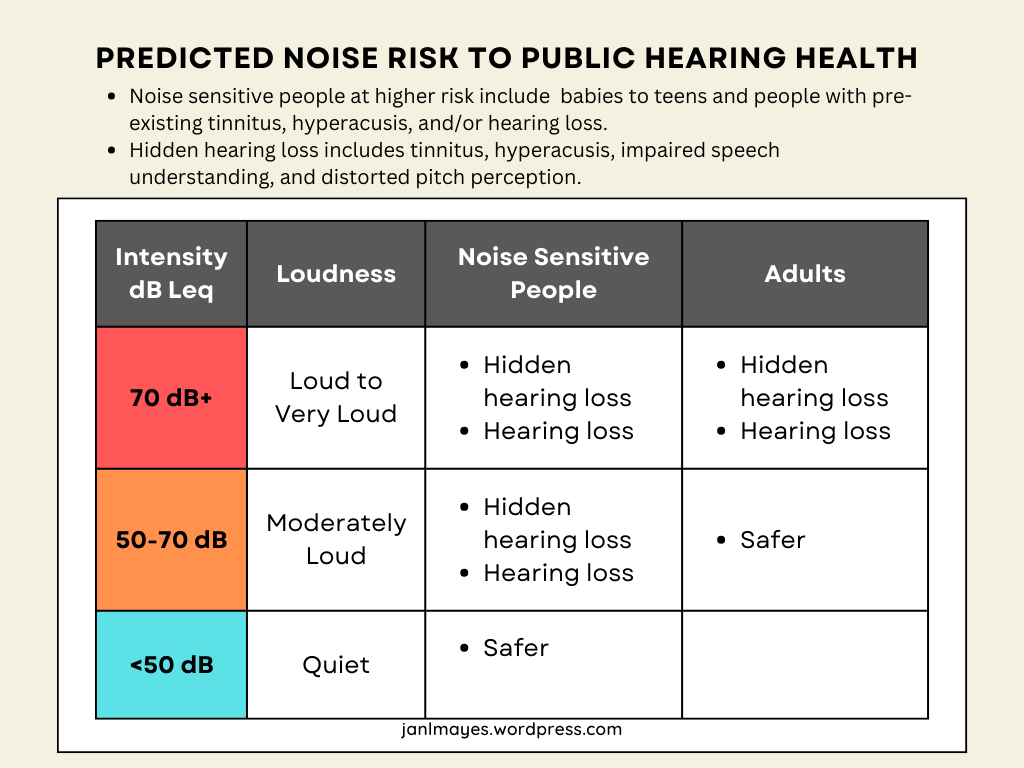
Noise= Amplified and/or manufactured sound energy that exceeds public health recommended community, environmental, and night noise limits.
Noise Dose= There is no such thing as a “safe” noise dose, no matter how short the exposure or listening time (EPA, 1972; WHO, 1999-2019).
dB= decibels typically measured in Sound Pressure Level, dBA, or dBC (e.g. LAeq,24-hour; LCeq,24-hour). Time-weighted averages should never be used in public health (e.g. dB Lex,8-hour or 40-hour).
Note: Exposures <30-35 dB may be needed to protect total health e.g. bedrooms, classrooms, hospital rooms, nature preserves.
Read the article from Tinnitus Today: This is Your Brain on Noise.
 Jan L. Mayes